Rental Property Analysis Spreadsheet: Stress-Test Any Deal
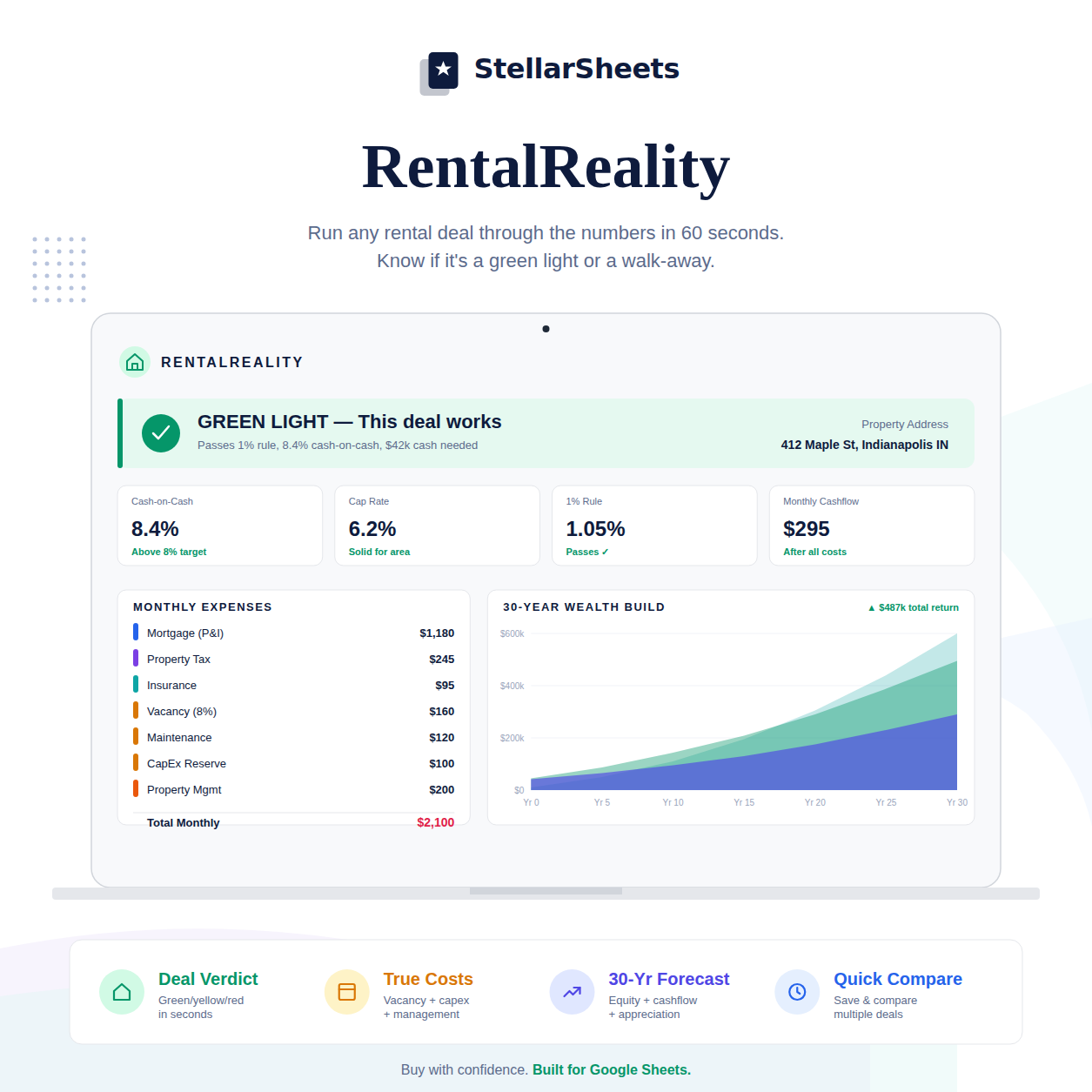
A Rental Property That "Cash Flows" on Paper Can Lose Money in Real Life
The math looks simple: rent minus mortgage equals cash flow. But that calculation ignores vacancy, CapEx reserves, property management, maintenance, taxes, and insurance — the expenses that routinely turn paper-positive deals into real-world negatives. A proper rental property analysis accounts for all of it before you wire a down payment.
This post walks through how to stress-test any deal in under 10 minutes.
The Inputs You Need Before You Can Analyze Anything
- Purchase price and down payment
- Interest rate and loan term
- Expected monthly rent — verify with Zillow, Rentometer, or local PM quotes, not just the seller's claim
- Vacancy rate — use 5–8% minimum; more in softer markets
- Property management — 8–12% of collected rent; model it even if self-managing
- CapEx reserves — 5–10% of gross rent monthly for roof, HVAC, appliances
- Maintenance — 1–2% of property value annually
- Property taxes and insurance — get actual numbers, never use national averages
The 5 Metrics That Tell You If a Deal Is Worth Pursuing
Monthly cash flow — rent minus all expenses including mortgage. The floor metric. Negative cash flow means you're subsidizing the property every month.
Cash-on-cash return — annual cash flow ÷ total cash invested (down payment + closing costs). Your real yield. 6%+ is solid; below 4% warrants scrutiny.
Cap rate — NOI ÷ property value. The financing-independent view of property performance. Useful for comparing deals across different financing structures.
Gross rent multiplier — purchase price ÷ annual gross rent. Quick filter: under 10 is worth deeper analysis; over 15 in a flat market is a red flag.
The 1% rule — monthly rent ≥ 1% of purchase price. A $200,000 property should rent for $2,000+/month. Properties that pass the 1% rule are more likely to cash flow after real expenses.
2026 Rental Market Context
Rising interest rates between 2022–2024 significantly compressed cash-on-cash returns for leveraged rental properties. In many markets, properties that cash-flowed at 3% rates are now cash-flow negative at 6–7% rates on the same purchase price. This makes the stress-test more important than ever — and makes the offer price calculation (working backward from your target CoC return) the most valuable part of the analysis.
How to Stress-Test the Deal
A deal that only works under perfect conditions isn't a deal — it's a bet. Before making an offer, run these scenarios:
- Rent drops 10% — does it still cash flow?
- Vacancy hits 15% — what's the monthly impact?
- Interest rate rises 1% — if you're using adjustable financing, what's the worst case?
- CapEx hits in year 2 — roof replacement, HVAC failure; does your reserve cover it?
If the deal survives all four scenarios with acceptable returns, you've found something worth pursuing. If it only works when everything goes right, walk away.
Using the Analysis to Set Your Offer Price
Your analysis isn't just a go/no-go tool — it's a negotiation weapon. Ask: what purchase price gets me to a 7% cash-on-cash return? Adjust the price input until CoC hits your target. That's your offer price — a mathematically justified number you can defend to the seller.
The 30-Year Picture
Month-one cash flow is only part of the story. A rental property also builds equity through mortgage paydown and appreciation. A deal with modest cash flow but strong equity buildup in an appreciating market may outperform a high-cash-flow deal in a flat market over 30 years. Model both.
Rental income also contributes to your overall net worth trajectory. For a complete picture of how real estate fits into your financial independence plan, see How to Calculate Your FIRE Number — rental income reduces the portfolio size you need to retire.
Rental Property vs. Stock Market: The Real Comparison
Rental properties offer leverage, depreciation tax benefits, and inflation-hedged income. Stock index funds offer liquidity, diversification, and zero management overhead. Neither is universally better — but the comparison only makes sense when you're using real numbers for both. A rental property with a 4% cash-on-cash return and 3% appreciation competes differently against a 7% stock return than one with 8% CoC and 5% appreciation.
Frequently Asked Questions
What is a good cash-on-cash return for a rental property?
Most real estate investors target 6–10% cash-on-cash return. Below 4% is generally considered weak unless you have a strong appreciation thesis. Above 10% is excellent and increasingly rare in competitive markets.
What is the 1% rule in real estate?
The 1% rule states that monthly rent should be at least 1% of the purchase price. A $250,000 property should rent for $2,500+/month. Properties that pass the 1% rule are more likely to cash flow after real expenses, though the rule is harder to hit in expensive markets.
What is cap rate and how do I calculate it?
Cap rate = Net Operating Income ÷ Property Value. NOI is gross rent minus all operating expenses (excluding mortgage). Cap rate is financing-independent — it tells you the property's return regardless of how you financed it, making it useful for comparing deals.
Should I model property management even if I self-manage?
Yes. Modeling property management (8–12% of rent) even when self-managing gives you a realistic picture of the property's economics and ensures the deal works if you ever want to stop self-managing. A deal that only works because you're providing free labor isn't a real investment.
How do I account for CapEx in my rental property analysis?
Budget 5–10% of gross monthly rent for CapEx reserves. On a $2,000/month rental, that's $100–$200/month set aside for roof, HVAC, water heater, appliances, and other major repairs. This money should sit in a separate account and not be counted as cash flow.
Ready to Put This Into Action?
The math behind freedom is simple. The RentalReality – Rental Property Analyzer calculates cap rate, cash-on-cash return, and 30-year projection instantly — with what-if modeling built in. Pre-built formulas, instant download, yours forever.
Or browse the full Savings & Investing Templates collection to find the right tool for your situation.
-
Posted in
analyzer, cash flow, google sheets, real estate investing, rental property