The Real Take-Home Pay Calculator for Freelancers
Your Invoice Says $8,500. Your Bank Account Tells a Different Story.
Freelancers get paid in gross. Everything else — self-employment tax, income tax, health insurance, business expenses, retirement contributions — comes out of that number before you see real take-home pay. Most freelancers have a rough sense of this. Very few have calculated it precisely.
The result: lifestyle decisions made on gross revenue instead of net income. Rates set without knowing the actual margin. Tax bills that arrive as surprises every April.
The Real Take-Home Pay Formula for Freelancers
Gross Revenue
− Business Expenses
= Net Profit
− Self-Employment Tax (15.3% on net profit, though you deduct half)
− Federal + State Income Tax (on net profit minus half of SE tax)
− Health Insurance Premiums
− Retirement Contributions (Solo 401k, SEP-IRA, etc.)
= Real Take-Home Pay
For a freelancer grossing $80,000/year with $10,000 in business expenses, the math looks roughly like this:
- Net profit: $70,000
- Self-employment tax: ~$9,890 (but you deduct half, so ~$4,945 reduces taxable income)
- Federal income tax (22% bracket, after deductions): ~$10,500
- State income tax (varies): ~$3,500
- Health insurance: ~$6,000
- Retirement contributions: ~$5,000
- Real take-home: ~$40,110
That's a 50% effective take-home rate on gross revenue. Most freelancers guess 60–70%. The gap is where the surprises come from.
The 2026 Self-Employment Tax Breakdown
SE tax is 15.3% of net profit — 12.4% for Social Security (up to the $176,100 wage base in 2026) and 2.9% for Medicare (no cap). You can deduct half of SE tax from your gross income, which reduces your federal income tax bill. For the full quarterly payment calculation, see Self-Employed Tax Calculator: How Much to Set Aside Each Quarter.
The Quarterly Tax Problem
Freelancers are required to pay estimated taxes quarterly — April 15, June 15, September 15, January 15. Miss a payment or underpay and you owe a penalty. Overpay and you've given the IRS an interest-free loan.
The right quarterly payment is roughly 25–35% of your net profit, paid four times a year. The problem: most freelancers don't know their estimated annual liability until they're filing. So they guess. And they're usually wrong.
The fix: track net profit monthly, apply your effective tax rate, and set aside that amount in a separate account. When quarterly payments are due, the money is already there.
What Your Effective Hourly Rate Actually Is
Take your real take-home pay and divide by the hours you actually worked — including admin, client communication, revisions, and business development. Not just billable hours.
A freelancer billing $100/hour for 20 billable hours/week but spending 15 hours on non-billable work has an effective rate of $100 × 20 ÷ 35 = $57/hour before taxes. After taxes and expenses, closer to $30–35/hour.
Knowing this number changes how you evaluate clients, projects, and rates. A client who pays $75/hour but requires minimal revisions and admin may be more profitable than a client paying $100/hour who requires constant back-and-forth. For a full breakdown of client profitability analysis, see Freelance Income Tracker: How to Actually Know If Your Business Is Profitable.
The Business Expense Deduction You're Probably Missing
Every legitimate business expense reduces your net profit — which reduces both your SE tax and your income tax. Common missed deductions: home office (proportional share of rent/utilities), professional development, software subscriptions, health insurance premiums (deductible on Schedule 1), and the employer-equivalent portion of SE tax. For the full Schedule C category list, see How to Track Business Expenses for Schedule C.
The Rate Increase Math
Once you know your real take-home rate, the rate increase decision becomes straightforward. If you want to take home $60,000/year and your effective take-home rate is 50%, you need to gross $120,000. Divide by your billable hours and you have your target hourly rate. Most freelancers who do this math for the first time discover they need to raise rates by 20–40% to hit their actual income goals.
Frequently Asked Questions
What percentage of freelance income goes to taxes?
Most freelancers pay 25–35% of net profit in combined SE tax, federal income tax, and state income tax. The exact percentage depends on your net profit, filing status, deductions, and state. Higher earners in high-tax states may pay 35–40%.
What is the self-employment tax rate in 2026?
15.3% of net self-employment income — 12.4% for Social Security (up to the $176,100 wage base) and 2.9% for Medicare. You can deduct half of SE tax from your gross income when calculating federal income tax.
How do I calculate my real take-home pay as a freelancer?
Start with gross revenue. Subtract business expenses to get net profit. From net profit, subtract SE tax (15.3%, less the half you deduct), federal and state income tax, health insurance premiums, and retirement contributions. What remains is your real take-home pay.
What is an effective hourly rate for freelancers?
Your effective hourly rate is your real take-home pay divided by total hours worked — including non-billable time like admin, revisions, and business development. It's almost always lower than your quoted rate and is the most accurate measure of what you actually earn per hour.
How much should a freelancer charge to make $100,000?
At a 50% effective take-home rate, you need to gross $200,000 to take home $100,000. At 1,000 billable hours/year (roughly 20 hours/week), that's a $200/hour rate. At 1,500 billable hours/year, $133/hour. The exact number depends on your expense deductions, tax situation, and non-billable time ratio.
Ready to Put This Into Action?
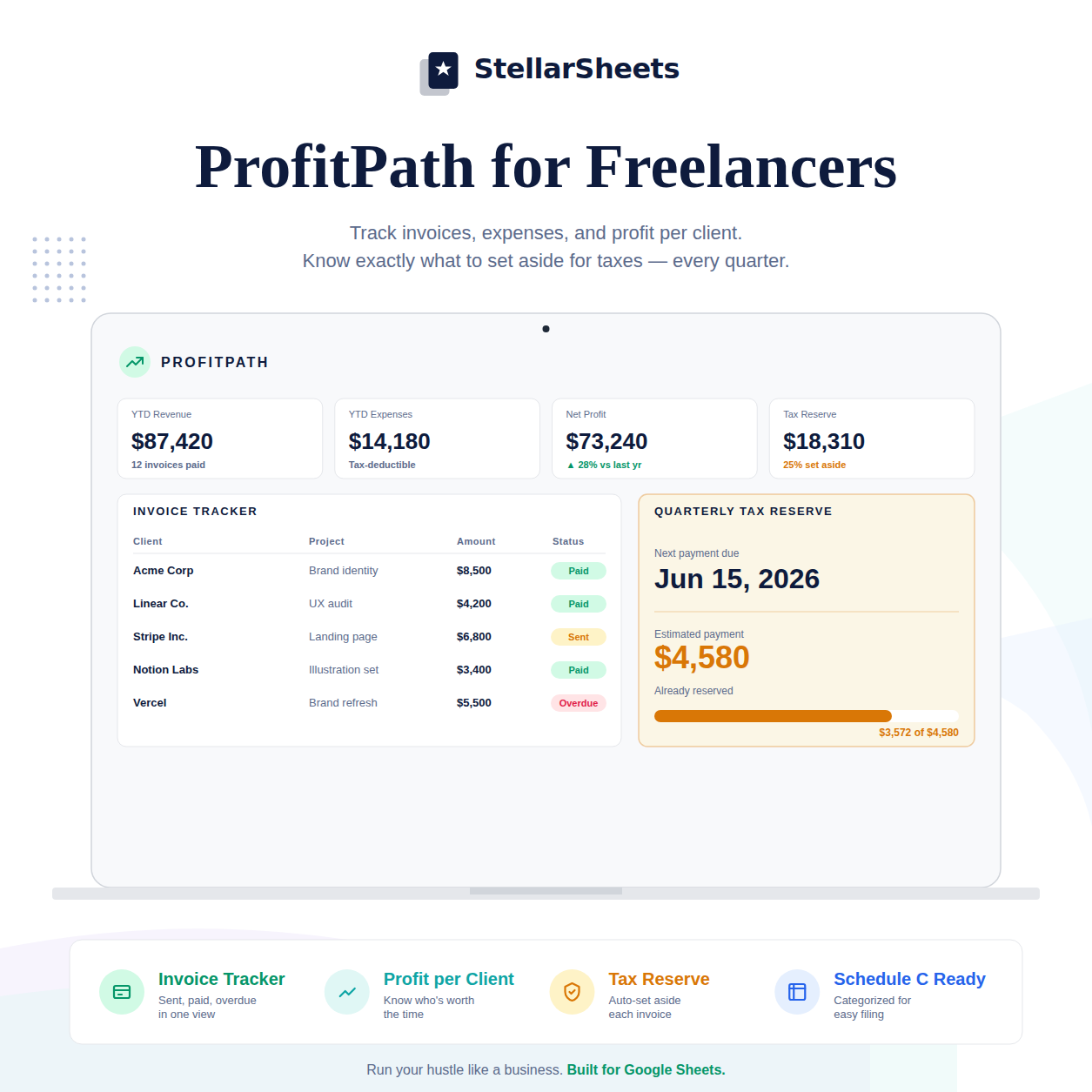
Knowing the strategy is step one. Having the right tool is step two. ProfitPath for Freelancers – Google Sheets tracks invoices, expenses, profit per client, and quarterly taxes in one pre-built dashboard. Instant download, yours forever.
Or browse the full Budgeting Templates collection to find the right tool for your situation.
-
Posted in
freelancer, google sheets, income tracker, self-employed, taxes