The "Subscription Creep" That's Quietly Costing You $1,800/Year
Subscription Creep Is the Financial Equivalent of a Slow Leak
You don't notice it happening. One month you add a streaming service. A few months later, a software tool for a project. Then a news subscription during a big news cycle. An app upgrade that seemed worth it at the time. A fitness subscription you fully intended to use.
None of these feel like decisions. They feel like small conveniences. And then one day you add them up and realize you're paying $150/month for things you barely use — $1,800/year leaving your account quietly, automatically, invisibly.
Why Subscription Creep Is So Hard to Notice
Small amounts don't trigger scrutiny. $9.99/month doesn't feel like a decision. $119.88/year does. Subscriptions are priced monthly specifically because the monthly number is psychologically easier to accept.
Auto-renewal removes the decision point. You made one decision — to sign up. After that, the subscription continues until you actively cancel. Most people never actively cancel anything.
Annual subscriptions are invisible 11 months a year. They hit once, you forget about them, and they renew again before you've thought about whether you still want them.
Free trials exploit optimism. You sign up thinking you'll cancel before the trial ends. You don't. The subscription starts. You forget. It runs for months.
The $1,800 Calculation
Here's how subscription creep typically adds up for the average person:
- 3 streaming services: $45/month
- 2 software subscriptions: $25/month
- News/media subscription: $15/month
- Fitness or wellness app: $15/month
- Cloud storage upgrade: $10/month
- 2–3 forgotten/unused subscriptions: $25–40/month
- Total: $135–$150/month = $1,620–$1,800/year
That's before the annual subscriptions that hit once and get forgotten. Add those and the number often exceeds $2,000/year.
The Subscription Audit: How to Find Everything
Pull 3 months of bank and credit card statements. Look for every recurring charge — weekly, monthly, quarterly, annual. List each one with its monthly cost equivalent and the last date you actually used it.
Then ask one question for each: if this subscription disappeared tomorrow, would I notice? If the answer is "probably not," cancel it.
The Renewal Calendar: How to Prevent It From Coming Back
After the audit, log every remaining subscription's renewal date. Set a reminder 30 days before each annual renewal. When the reminder hits, make a conscious decision: keep or cancel. You're never surprised by a charge again, and you're never paying for another year of something you stopped using.
What to Do With the Savings
The average person who completes a subscription audit finds $100–$300/month in cancellable charges. Redirect that to your debt payoff target, emergency fund, or investment account. The audit pays for itself in the first month — and every month after.
Ready to Put This Into Action?
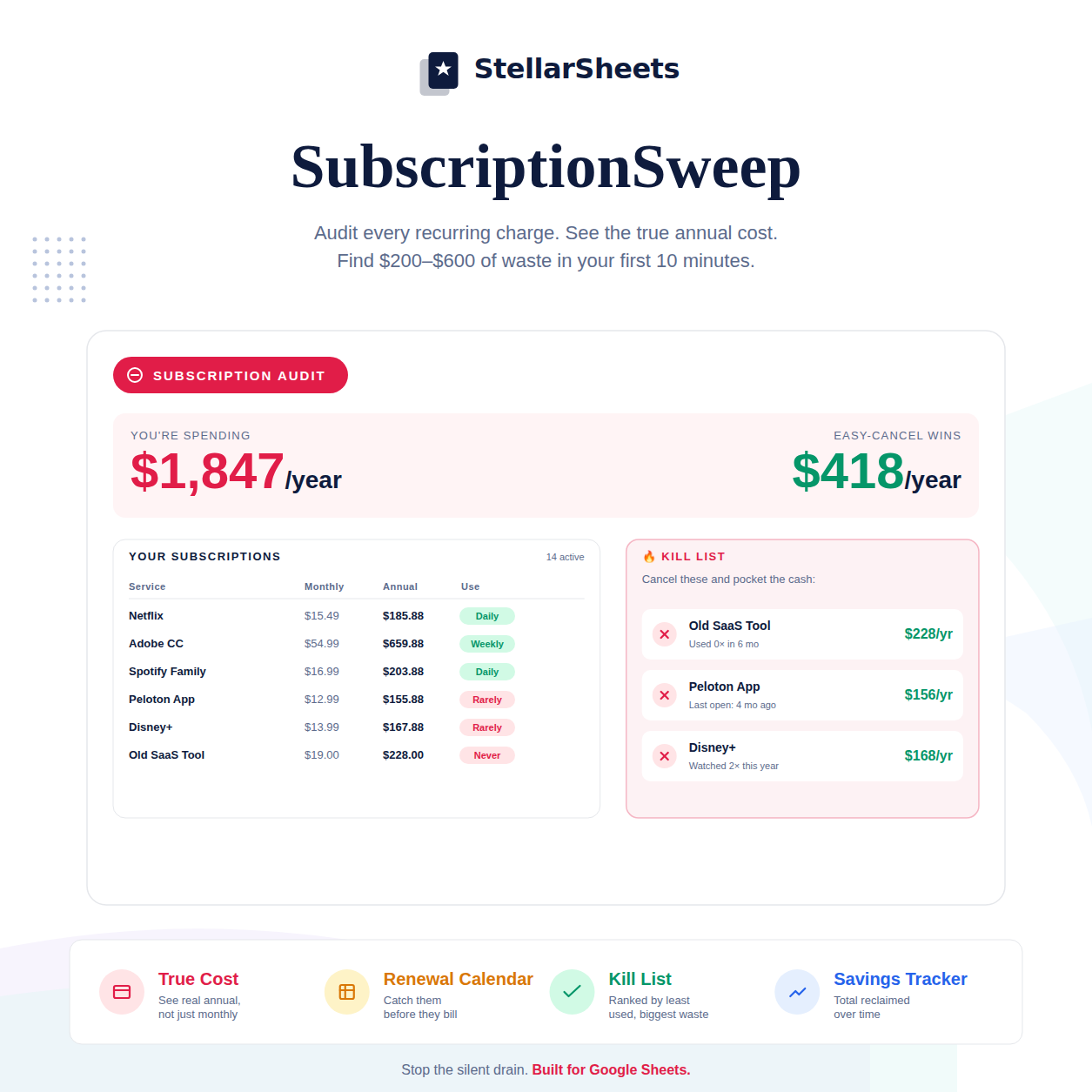
Knowing the strategy is step one. Having the right tool is step two. SubscriptionSweep – Google Sheets lists every recurring charge, calculates your true annual cost, flags unused subscriptions, and tracks renewal dates — all in one pre-built dashboard. Instant download, yours forever.
Or browse the full Budgeting Templates collection to find the right tool for your situation.
-
Posted in
budgeting, recurring charges, save money, subscription creep, subscriptions