I'm a Freelancer Making $80K and I Can't Figure Out If I'm Profitable
$80K in Revenue. No Idea What I Actually Made.
This is more common than it sounds. Freelancers track invoices. They watch the revenue number grow. They feel busy and productive. And then tax season arrives and the number on the return is somehow much lower than expected — and the bank account doesn't reflect the revenue either.
The problem isn't the revenue. It's the gap between revenue and profit that nobody calculated along the way.
The Four Numbers That Tell You If You're Actually Profitable
Gross revenue — total invoiced and collected. The number most freelancers know.
Net profit — gross revenue minus all business expenses. The number most freelancers don't know. Business expenses include software, equipment, home office, professional development, health insurance (if self-employed), and anything else you spend to run the business.
Effective hourly rate per client — net revenue from that client ÷ total hours worked for them (including admin, revisions, communication). Some clients look great on revenue but are low-margin after accounting for the actual time they consume. This number tells you who's worth keeping.
Quarterly tax liability — the amount you owe in estimated taxes each quarter. Self-employment tax is 15.3% on net profit. Add federal and state income tax and you're typically setting aside 25–35% of net profit for taxes. Most freelancers either over-set-aside (cash flow problem) or under-set-aside (penalty problem). Knowing the right number eliminates both.
The Profitability Calculation Most Freelancers Skip
Take your gross revenue. Subtract every business expense. That's your net profit. Multiply by your effective tax rate (typically 28–35% for self-employed). Subtract that. What's left is your real take-home.
For a freelancer grossing $80,000 with $12,000 in business expenses:
- Net profit: $68,000
- Self-employment tax: ~$9,600
- Federal + state income tax: ~$12,000
- Real take-home: ~$46,400
That's a 58% take-home rate on gross revenue. Most freelancers guess 70–75%. The gap is where the surprises come from.
The Client Profitability Problem
Not all $80K is created equal. A client paying $5,000/month for 20 hours of work is very different from a client paying $5,000/month for 60 hours of work, constant revisions, and weekly calls. The revenue looks identical. The profitability is completely different.
Calculate your effective hourly rate for each client: total revenue from that client ÷ total hours worked. Then rank your clients by effective hourly rate. The bottom of that list is where you should be raising rates or firing clients.
The Fix: A System That Tracks All Four Numbers
Log every invoice with client, amount, and date. Log every business expense with category (for Schedule C). Track hours per client. Calculate net profit monthly. Set aside the right percentage for quarterly taxes as you go — not as a lump sum at year end.
Five minutes a week. Completely changes your visibility into whether the business is actually working.
Ready to Put This Into Action?
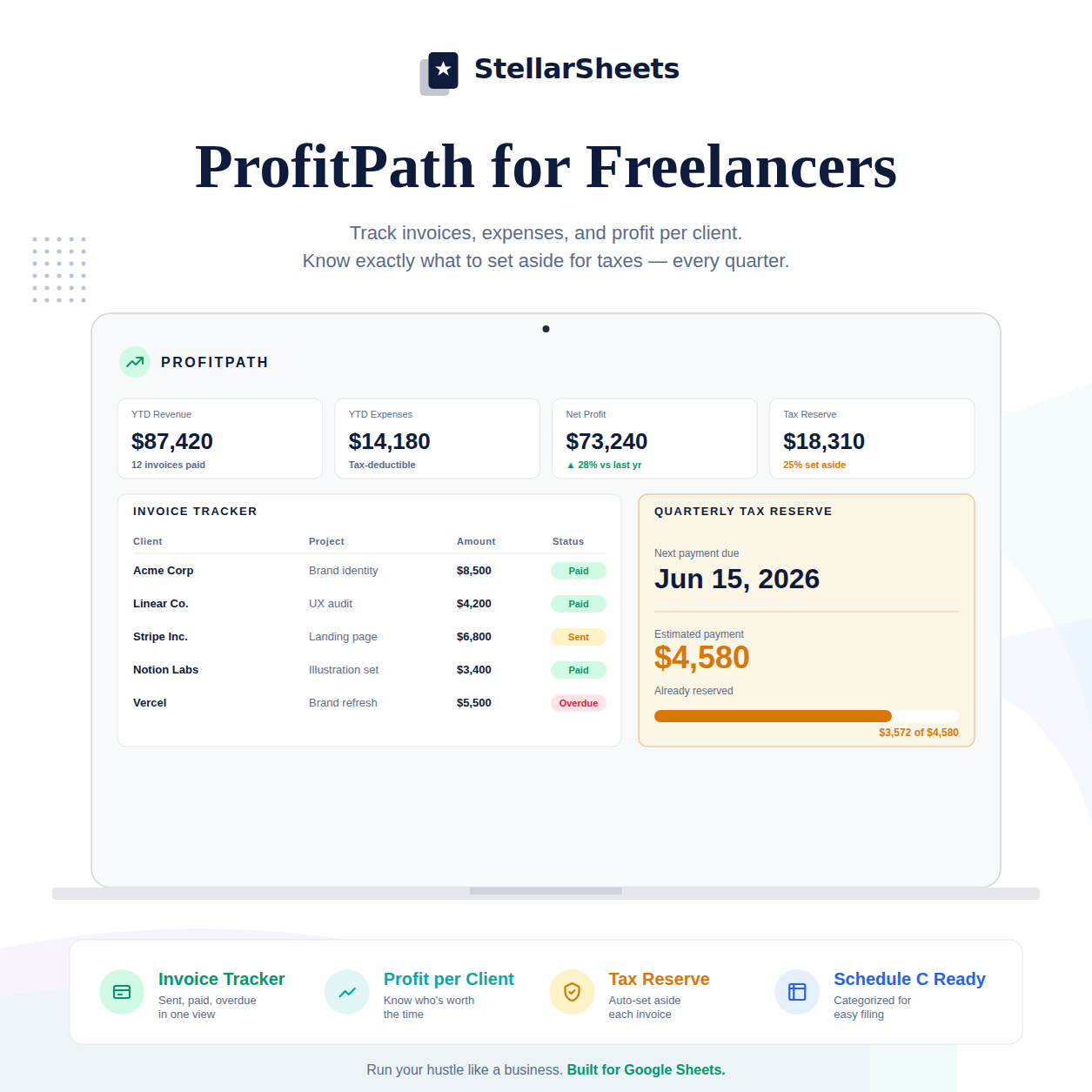
Knowing the strategy is step one. Having the right tool is step two. ProfitPath for Freelancers – Google Sheets tracks invoices, expenses, profit per client, and quarterly taxes in one pre-built dashboard. Instant download, yours forever.
Or browse the full Budgeting Templates collection to find the right tool for your situation.
-
Posted in
freelancer, income tracking, profit, self-employed, taxes